
Business & liquidity planning
Know how much capital your project needs — and when.
Business case, capex and opex, cost per gram, scenarios and a monthly liquidity plan through construction and ramp-up — for medical-cannabis facilities and cultivation associations, built with Research Gardens' own planning software.
- Derived from the layout: change a room, and the numbers follow
- Stage plan: expand as soon as the cash flow can fund it
- Excel/CSV export for banks and advisers
For investors and financial planners, banks, boards and members of cultivation associations, and medical-cannabis start-ups
Liquidity plan
schematic
Cumulative cash flow before financing
- companies advised along the value chain
- 45+
- weeks for feasibility, layout and liquidity plan (example: medical facility)
- ~3
- months from kick-off to commissioning of a medical facility
- 18–24
- cultivation associations & CSCs among our references
- 24
01 The problem
Why good projects run out of money
Between kick-off and the first revenue lie permit, construction, commissioning and ramp-up — for a medical facility, commissioning alone typically comes 18–24 months after kick-off. A plan that gets this stretch wrong ends up looking for follow-on financing exactly when the negotiating position is weakest.
- 01
The run-up is underestimated
Permit, construction, commissioning and ramp-up take longer than the plan assumes. Every month of delay costs rent, staff and interest — with no revenue to set against it.
Our approach A monthly liquidity plan from kick-off to steady operation, including delay scenarios.
- 02
Assumptions without a source
Yield per square metre, cycles per year or the price per gram come from manufacturer claims or unchecked rules of thumb rather than from the room programme and the market. The first critical question from a bank or investor exposes it.
Our approach Every assumption derived from the operating model — estimates clearly labelled as such.
- 03
Only one scenario
A plan with a single price leaves the obvious questions open: what if prices fall, yields stay below target or the permit takes longer?
Our approach Scenarios side by side and a sensitivity analysis of the key drivers.
- 04
Plans that drift apart
Layout, capex list, business plan and liquidity plan live in separate files. After a few layout revisions, management, board and investors are looking at different numbers.
Our approach One model from floor plan to balance sheet — change the layout, and every figure follows.
02 Own planning software
From floor plan to financing plan — in one model.
Business plans are usually built separately from the facility planning — and drift further apart with every layout change. Research Gardens' own planning software works the other way round: the layout drives the technical sizing, and capex, opex, P&L, balance sheet and liquidity are derived from it. Scenarios are faster to model, and management and investment planning stay consistent.
-
Step 01
Layout
Rooms drawn from scratch or traced on your floor-plan PDF, calibrated to scale. Area, volume, air changes and airflow per room; 2D and 3D views, several floors and buildings.
Output Dimensioned plan (PDF) and room list
-
Step 02
Technical sizing
A climate model per room type — flowering, veg, mother plants, clones, wash area, drying — with cooling and dehumidification loads for summer and winter. Ducts sized to airflow, air-handling units, and chilled-water, drinking-water and irrigation lines sized to the load; benches, lights and irrigation per room.
Output Equipment and cost per room
-
Step 03
Stage plan & capex
Organic expansion financed from cash flow: the GACP/GMP core is planned for the final build-out and built first. Further cultivation stages follow as soon as starting budget and surplus can fund them — in as many stages as the cash flow allows, without interrupting production.
Output Capex list and payment calendar
-
Step 04
P&L, balance sheet, liquidity
A monthly engine turns the plan into volumes, P&L, balance sheet and liquidity — down to the smallest financing plan: how much capital has to be available, and when.
Output Projected financial statements and financing plan
Change the layout — capex, opex and liquidity follow automatically
-
The smallest financing plan
How much capital has to be available, and when? The software derives it from the monthly cash curve — including capex payments, VAT pre-financing until the refund arrives, start-up losses, first revenues and a minimum cash reserve.
-
Build in stages, grow from cash flow
A financing autopilot schedules each follow-on stage for the earliest month the cash flow can fund it. When a room produces is modelled separately from when it is built and paid for.
-
Outputs for bank, board and advisers
Liquidity, volumes, P&L, balance sheet, a capex list with payment calendar and room data sheets with a full-cost view — exportable to Excel/CSV. For investors: the IRR of the investor position and a DCF valuation.
-
A model that checks itself
The balance sheet is derived and has to balance — any difference is shown, a hard check on the whole model. A plausibility check flags issues such as negative cash, capex below the model, a GMP audit scheduled after the start of sales, or a stage that relies on fresh equity instead of cash flow.
-
Scenarios and locations
Key-figure snapshots of different scenarios side by side. A location profile moves the same layout to another site — with a wage factor on installation and an import surcharge on technology.
-
Prices with a source
Rule-of-thumb prices are labelled as such and calibrated against real quotes and orders where available — so everyone can see which figures are still estimates.
Monthly engine
- Time grid
- monthly; view by quarter, half-year or year
- Harvest
- planting + cycle lead time
- Costs
- from planting
- Build vs. production
- modelled separately
- Rent
- user-defined start
- VAT
- pre-financing & refund lag
- Payment terms
- included
- Staff
- per role, with wage escalation
- Taxes & depreciation
- included
- Financing
- equity, loans, leasing, distributions
- Expansion stages
- as many as the cash flow can fund
- Export
- Excel / CSV
Scenario comparison
schematic
03 What's included
From business case to financing documents
Depending on the project stage, we combine the modules you need — from a first feasibility check to the complete financing package.
- 01
Business case
Is the project viable? Market and sales assumptions, revenue or contribution logic — the basis for the go/no-go decision.
- 02
Capex plan & payment calendar
Investment per room, derived from layout and technical sizing — with a payment calendar and, where it makes sense, a staged build-out.
- 03
Opex & cost per gram
Running costs from energy and staff to rent, testing and maintenance; a full-cost view per room and the resulting cost per gram.
- 04
Yield & price scenarios
Yield per m² and cycle and price assumptions — conservative, base and optimistic cases side by side.
- 05
Sensitivity analysis
Which assumption moves the result most — price, yield, energy or a delayed ramp-up? So it is clear which assumptions need the strongest evidence.
- 06
Liquidity plan & capital requirement
Month by month from kick-off through construction and ramp-up: how much capital has to be available, and when — including VAT pre-financing and a minimum cash reserve.
- 07
P&L, balance sheet & investor metrics
Integrated projected P&L, balance sheet and liquidity; IRR of the investor position and a DCF valuation — with Excel/CSV export for banks and advisers.
- 08
Financing documents & investor materials
Business plan document and the numbers part of your investor presentation — structured the way banks and investors read them. With investor-relations experience from a planned medical-cannabis facility.
- 09
Membership & contribution models
For cultivation associations: member numbers, membership build-up and contribution structure — calculated so that contributions cover the association's costs. Economic planning, not legal advice.
Free for cultivation associations
CSC financial planner: a first estimate in a few minutes
From the target number of members and the demand per member to the cultivation area you need — and on to investment, running costs and liquidity. Good for a first orientation on the board; for banks, members or authorities we then build your plan in detail.
04 Cultivation associations
Contributions that sustain the association
Under the German Consumer Cannabis Act (KCanG), cultivation associations grow on a non-commercial basis. The economic question is therefore a different one: not the margin, but whether the members' contributions reliably cover investment and running costs — including while the membership is still growing.
Economics, not legal advice
We plan the numbers. Whether a contribution model fits your statutes and the KCanG should be checked by a lawyer — on request, we put you in touch with law firms from our partner network.
Questions we answer with you
- How many members does it take for contributions to cover the running costs?
- What does a gram cost the association — and what does that mean for the level of contributions?
- How can the initial investment be financed without the association running out of cash during set-up?
- Buy, lease or rent the cultivation space or container?
- Which contribution structure is transparent for members and the board?
Practical example
CBG Hannover — a cooperative combining a cannabis social club and a cultivation association. Facility planning, use of funds and strategic decisions, accompanied on the supervisory board (2025–2026).
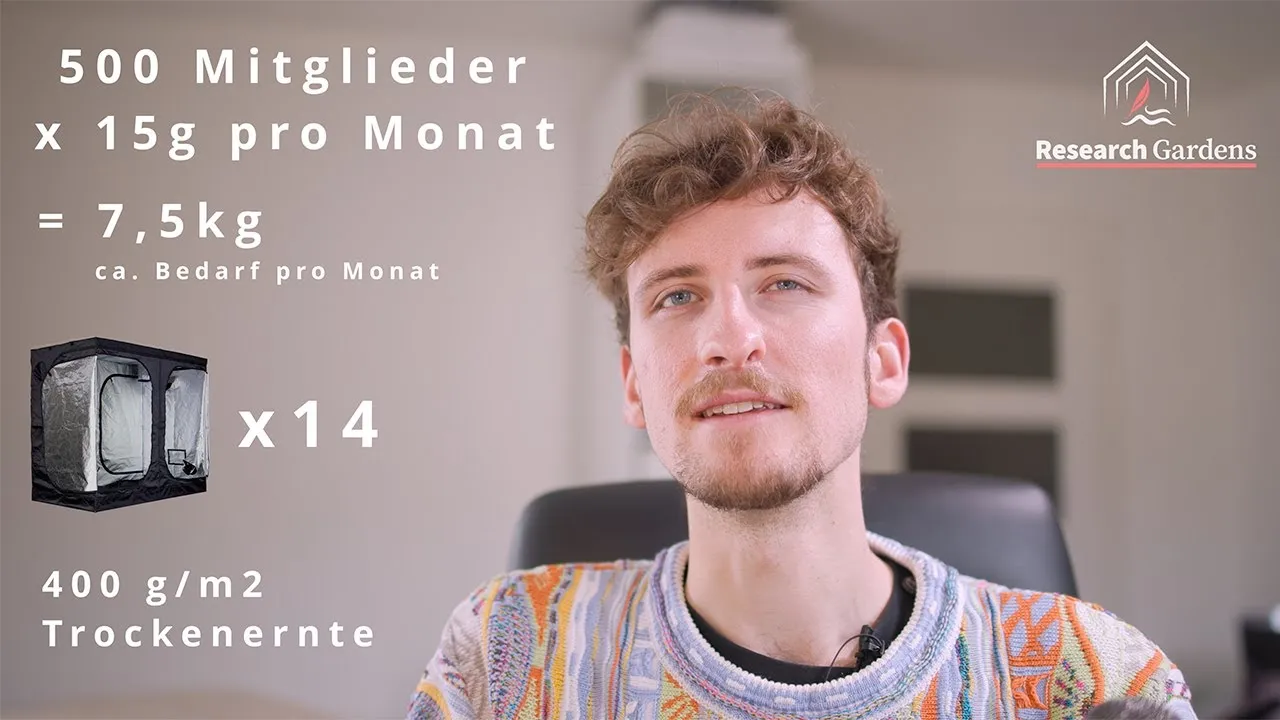
On YouTube: the economics of cultivation associations
Videos in German
-
Two years of CSC planning
-
Facility costs & limit values
-
Securing the investment
-
Quantities, prices, investment

05 Procedure
Five steps — anchored in the project phases
Business & liquidity planning across the project
- 1 Feasibility
- 2 Planning
- 3 Financing
- 4 Quality
- 5 Operation
Focus Supporting
- 1
Kick-off & documents
Goal and audience of the plan (bank, investors or members), project status and existing documents: site, floor plan, quotes, staffing and price assumptions.
Phase 1 · Feasibility
- 2
Layout, technology & operating model
We sketch the layout with you or trace your floor plan to scale. On that basis we model the technical equipment and size it — climate units and cooling capacity, ventilation, pipework, benches and lighting — along with cycles, yields and staffing.
Phase 1–2 · Feasibility & planning
- 3
Business case & capex
Capex per room, opex, cost per gram and the stage plan — the basis for the go/no-go decision.
Phase 1 · Feasibility
- 4
Scenarios & financing plan
Liquidity month by month, scenarios and sensitivities — and the smallest financing plan: how much capital, and when.
Phase 3 · Financing
- 5
Documents & updates
Financing documents and Excel/CSV export. On request, we update the plan as quotes, permits and the first harvests come in.
Phase 3–5 · Financing to operation
In the example of a medical facility, feasibility, room programme and the business and liquidity plan are in place after about three weeks; commissioning follows 18–24 months after kick-off.
06 Track record
Planning experience from both sides of the table
- since August 2026
Two production projects in Germany · 5 t (Hanapharm) and 20 t per year
Ongoing planning work for two facilities with a planned annual capacity of 5 and 20 tonnes.
- since August 2026
Production project in the Czech Republic · 12 t per year
Ongoing planning work for a facility with a planned annual capacity of 12 tonnes.
- since October 2026
Production project in Türkiye · 5 t per year
Ongoing planning work for a facility with a planned annual capacity of 5 tonnes.
- since 2023
380 nanometer · planned medical-cannabis facility, Germany
Investor relations, facility design and quality-system development for a planned medical-cannabis facility in Germany.
- 2025 – 2026
Supervisory board, CBG Hannover
A cooperative combining a CSC and a cultivation association: oversight of the use of funds, facility planning and strategic decisions.
- since 2021
Research Gardens
45+ companies advised along the value chain — strategy, business plans, operating models and liquidity planning; company valuations and due diligence for acquisitions from an SME perspective; own planning software.
- 2022 – 2024
Alpine Biolabs (AT) · Head of IT & QMS
Plant lab for pathogen testing, tissue culture and clones: support for the business model and liquidity planning.
- 2020 – 2021
Vapes'n'Dabs (CH) · Head of Cultivation
Built and ran a 1-hectare outdoor CBD cultivation plus indoor production, including business planning — the cost side of cultivation, learned in operation.
- 2016 – 2019
Foundation
Business informatics (DHBW Mosbach) and IT internal audit at Schwarz Dienstleistungen (Lidl/Kaufland), then horticultural sciences (HTW Dresden): models, controls and plants.
45+ organisations advised — a selection
Selection across all service areas












Your contact
Lorenz Minks
Research Gardens is a consultancy based in Küsnacht (Zurich) with a network of specialised partners. You work directly with me — from the first assumption to the finished financing documents.
I studied business informatics and horticultural sciences, ran a cultivation and started out in IT audit. That is why, for me, a liquidity plan starts in the grow room: with areas, cycles and yields — and only then in the model.
In the German industry I serve on the board of the BVCW and coordinate the BCAv, where I lead the working group on risk minimisation and product safety.
Partners for questions beyond the numbers
Strategy, construction, technology and legal questions: where a plan needs more than numbers, we involve partners from the network.
-
Strategy consulting
-
Rentable grow containers
-
Facility engineering
-
General contractor
-
Technical room planning
-
Lighting
-
Legal advice
Further reading
Related services and articles
- Facility & grow-room planning The room programme and layout the business plan is built on.
- Due diligence & company valuation Independent review of an existing business plan, facility or company before you invest.
- ERP, configurators & software tools Planning tools, configurators and ERP modules — built around your processes.

FAQ
Frequently asked questions
Can you review an existing business plan instead of building a new one?
Yes. We check assumptions, logic and liquidity and show where the plan is vulnerable — as a basis for revising it or for an investment decision. For investors, this review is part of our due diligence.
Due diligence & company valuationWhich documents do you need from us?
Whatever exists: site details, a floor plan or sketch, quotes, staffing and price assumptions and the intended financing. A floor-plan PDF can be traced to scale directly. Where figures are missing, we use rule-of-thumb values, label them as such and replace them with real quotes as they come in.
How long does the planning take?
That depends on the scope and the data available. In the example of a medical facility, feasibility, room programme and the business and liquidity plan are in place after about three weeks. After the first meeting you receive a concrete offer.
Will the bank accept the plan?
No one can promise a financing decision — it lies with the bank or the investor. What we can do: make every assumption traceable, show scenarios and liquidity month by month, and hand over the model as an Excel/CSV export so that banks and advisers can check it themselves.
Do you also advise our association on legal questions under the KCanG?
No. We plan the economics — member numbers, contributions, costs and liquidity. Statutes, fee rules and other legal questions belong with a lawyer; on request, we put you in touch with law firms from our partner network.
Can we keep working with the plan ourselves?
You receive the results as documents and as an Excel/CSV export for your own controlling, your bank and your advisers. On request, we update the plan as quotes, permits and the first harvests come in.
Next step
Let's run the numbers on your project.
In a free 30-minute call we clarify the goal and audience of the plan, the project stage and the data available — and what a sensible next step would be.
What we clarify in the first meeting
- Goal and audience: bank, investors or members
- Project stage: idea, layout or existing plan
- Data available: floor plan, quotes, prices
- Timeline and financing deadlines